
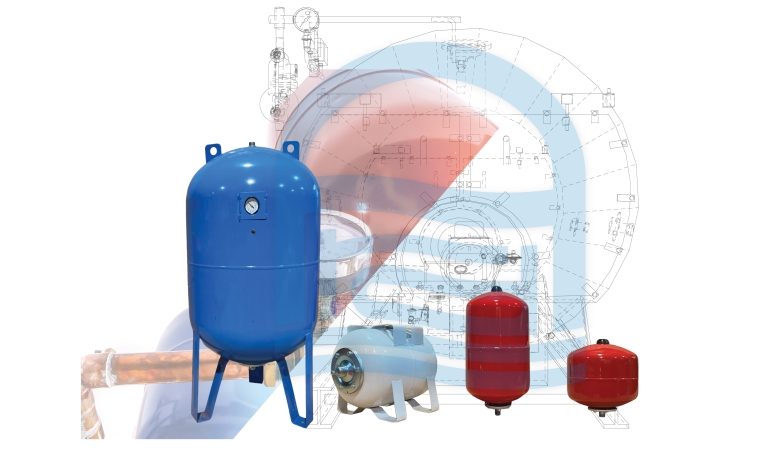
Waterline pressure vessels with replaceable mambrane. This line is Ideal For every modern installation and can be applied to any type oF pump. A compressor is not necessary since an air cushion, separated from the water by the EPDM membrane, maintains, a constant pressure in the tank. These tanks can also be provided with stainless steel flanges. Available capacities are from 2 to 5000 liters. They can certified by the PED/97/23/CE, WRAS and EN 13831.


Introduction
25 bar expansion vessels are devices that are used to maintain the pressure and volume of water in medium pressure systems, such as heating, cooling, and solar systems. They are also known as pressure vessels, expansion tanks, or accumulators. 25 bar expansion vessels have a maximum working pressure of 25 bar, which means they can withstand the pressure of water up to 25 times the atmospheric pressure.
Function and Structure
The main function of 25 bar expansion vessels is to compensate for the thermal expansion and contraction of water in the system. This causes changes in the pressure and volume of water in the system. If the pressure is too high, it can damage the pipes, valves, pumps, and other components of the system. If the pressure is too low, it can reduce the efficiency and performance of the system.
25 bar expansion vessels consist of two main parts: a steel shell and a flexible membrane. The steel shell is the outer casing of the vessel that protects it from external forces and corrosion. The flexible membrane is the inner part of the vessel that separates the water from the air or gas. The membrane is usually made of EPDM (ethylene propylene diene monomer) or butyl rubber, which are resistant to high temperatures and chemicals.
The water side of the membrane is connected to the system through a flange or a threaded connection. The air or gas side of the membrane is pre-charged with a certain pressure, usually 3, 4, or 6 bar. The pre-charge pressure is the minimum pressure that the vessel maintains in the system. The pre-charge pressure should be adjusted according to the static pressure and the safety valve setting of the system. When the water in the system is heated, it expands and pushes the membrane towards the air or gas side. This reduces the volume of the air or gas and increases its pressure. The vessel acts as a cushion that absorbs the excess pressure and volume of the water. When the water in the system is cooled, it contracts and pulls the membrane towards the water side. This increases the volume of the air or gas and decreases its pressure. The vessel acts as a spring that releases the stored pressure and volume of the water.
Types and Sizes
There are different types and sizes of 25 bar expansion vessels available in the market. Some of the common types are:
- **Waterline Over Pressure 25 Bar**: These are expansion vessels with a replaceable membrane for use in sealed heating and cooling systems. They have a standard pre-charge of 3, 4, or 6 bar and a maximum working temperature of 120 °C. They are suitable for addition of glycol-based anti-freeze up to 50%. They are delivered with a pressure gauge and height adjustable feet (except 1200 - 2000 litres).
- **Global Water Solutions UltraMax (25 bar) Range**: These are multifunctional tanks that are suitable for potable or non-potable applications. They have a replaceable membrane with a strong AISI 304 stainless steel inox flange.
- **16 Bar & 25 Bar Expansion Vessels**: These are expansion vessels with a replaceable membrane for use in medium pressure applications, such as booster systems, thermal expansion, irrigation systems, and hydraulic hammer arresting. They have a standard pre-charge of 3, 4, or 6 bar and a maximum working temperature of 120 °C. They have a red epoxy powder coating. They are delivered with a pressure gauge and are equipped with an inspection flange. The size of the 25 bar expansion vessel depends on the volume and temperature of the water in the system.
The size can be calculated using the same formula as for the 10 bar and 16 bar expansion vessels, but with a different maximum pressure value. For example, if the water capacity of the system is 3000 litres, the maximum temperature is 70 °C, the minimum temperature is 10 °C, the maximum pressure is 25 bar, and the pre-charge pressure is 4 bar, the size of the 25 bar expansion vessel can be calculated as follows:
V = k * C * (v1 - v0) / (p1 - p0)
V = 1.1 * 3000 * (0.001019 - 0.001003) / (25 - 4)
V = 19.98 litres
or V = 0.1 * C * (T1 - T0) / 100
V = 0.1 * 3000 * (70 - 10) / 100
V = 18 litres
Therefore, a 25 bar expansion vessel with a volume of around 18 litres would be suitable for this system.
Importance and Maintenance
25 bar expansion vessels are essential components of medium pressure systems. They help to regulate the pressure and volume of water in the system and prevent damage and inefficiency. They should be selected and installed according to the specifications and requirements of the system. They should also be maintained and checked regularly to ensure their proper functioning and safety.
Some of the maintenance and check procedures are:
- Checking the pre-charge pressure of the vessel and adjusting it if necessary.
- Checking the water pressure of the system and ensuring it does not exceed the maximum working pressure of the vessel.
- Checking the water temperature of the system and ensuring it does not exceed the maximum working temperature of the vessel. - Checking the condition of the membrane and replacing it if it is damaged or worn out.
- Checking the condition of the steel shell and painting it if it is corroded or rusted.
- Checking the condition of the flange and the connection and tightening them if they are loose or leaking. - Checking the condition of the pressure gauge and the Flexvent Super and replacing them if they are faulty or broken.
